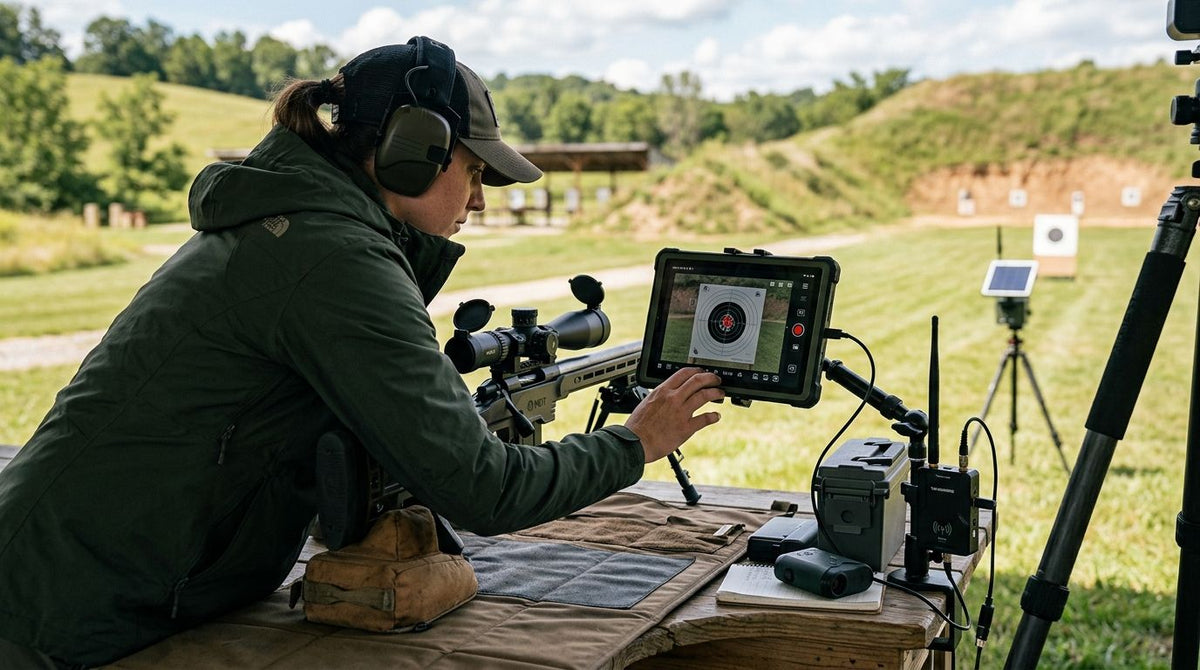
A target camera system's cost isn't one number — it's a function of how many shooting positions you need covered and how far downrange those positions sit. Longshot's lineup runs from a single clip-on scope camera to four-camera range kits, and the line item most buyers overlook is the tablet that actually displays your impacts.
- How much a target camera system costs depends mainly on camera count: Longshot's lineup runs from the single-camera Hawk to 4-camera LR-3 kits.
- The LR-3 carries a 2-mile straight shooter distance guarantee per camera, whether you buy one unit or a 4-camera kit.
- No Wi-Fi or cell service is required to run any Longshot target camera, which removes a hidden connectivity cost some setups carry.
- Buying a camera and the Longshot Tablet together adds a free Bulletproof Warranty, which changes the real cost math on a bundle.
- Best for multi-position ranges and squads: the LR-3 2-, 3-, or 4-camera kits. Best for a single shooter upgrading an existing scope: the Hawk.
Why this matters
Most buyers shop for a target camera the way they shop for a rifle scope: one price, one spec sheet. That's the wrong frame. A Hawk spotting scope camera clips onto glass you already own, while a 4-camera LR-3 kit is closer to a small range infrastructure purchase. The gap between those two setups is driven by camera count, distance requirement, and whether you're outfitting one shooter or a whole squad.
In 2026, the bigger shift is that buyers are starting to think about target cameras as part of a shooting and reloading data setup, not a one-off accessory. That changes what "worth it" means — a $0 line item like a tripod or a case matters less than whether the system pairs cleanly with a tablet and holds its distance guarantee.
How much does a target camera system cost?
The honest answer: it scales with camera count and distance, not a flat sticker price. Here's how the core Longshot tiers stack up on the factors that actually move cost:
| Tier | Camera count | Distance capability | Best for |
|---|---|---|---|
| Hawk | Clips onto your existing spotting scope | Limited by your scope's optics | Shooters who already own glass |
| Marksman-1 | 1 standalone camera | Mid-range single station | Dedicated single-position setups |
| LR-3 | 1 camera, expandable | 2-mile straight shooter guarantee | Long-range and ELR shooters |
| LR-3 Kits | 2, 3, or 4 cameras | Same 2-mile guarantee per camera | Team lines and multi-position ranges |
Verdict: the camera count you need drives the cost more than any single spec. A shooter running one bench doesn't need the same setup as a squad covering four lanes at once, and pricing follows that logic directly on each product page rather than a single published rate.
Hawk: one camera, your existing scope
The Hawk is the lowest-commitment entry point in 2026 because it doesn't replace your spotting scope — it turns it into a live-feed camera. Best for: shooters who already have a scope dialed in and just want to stop walking downrange to check paper. It won't out-guarantee the LR-3's 2-mile distance rating, but for most static ranges under that distance it doesn't need to.
LR-3: 2-mile guarantee, one camera
The LR-3 is Longshot's straight shooter, carrying a 2-mile distance guarantee as a standalone unit before you add a second, third, or fourth camera. Best for: ELR shooters and long-range hunters who need one reliable feed at extended distance rather than multiple lanes.
LR-3 Kits: scales to 2, 3, or 4 cameras
Once you need more than one position covered, the LR-3 kits step up in fixed configurations — 2-camera, 3-camera, and 4-camera — each carrying the same 2-mile guarantee per unit. Best for: club matches, team practice, and ranges running multiple lanes at once where one camera per shooter isn't practical to buy separately.
Marksman-1: single-position mid-range camera
The Marksman-1 sits between the Hawk and the LR-3 as a standalone unit built for one station. Best for: shooters at established mid-range distances who want a dedicated camera without stepping up to the LR-3's extended distance rating.
EC-3: adds one camera per unit
The EC-3 is an extra 2-mile-rated camera for shooters who already own a Longshot system and want to add a position without buying a full new kit. Best for: anyone scaling from one lane to two without starting over.


Why target camera cost varies
- Camera count — one lane costs less to equip than four lanes running simultaneously.
- Distance requirement — a 2-mile-rated system carries different engineering than a mid-range unit.
- Tablet bundling — buying the camera and Longshot Tablet together changes the total versus buying each separately.
- Warranty coverage — a Bulletproof Warranty bundled with a camera-and-tablet purchase shifts long-term cost of ownership.
- Mounting and accessories — tripods, cases, and chargers are separate line items on top of the camera itself.
- Permanent vs. portable install — a range running a fixed indoor or outdoor install has different setup needs than a shooter packing a kit to a match.
“The real cost question isn't the camera's price tag — it's how many positions you actually need covered.”
Related questions
Do I need Wi-Fi or cell service to run a Longshot target camera?
No Wi-Fi or cell service is required to run a Longshot target camera system in 2026. The camera and tablet communicate directly, which matters at ranges where cell signal doesn't reach the firing line.
How many cameras do I need for a multi-position range?
Most multi-position ranges need one camera per lane in active use, which is why Longshot sells fixed 2-, 3-, and 4-camera LR-3 kits instead of forcing buyers to piece together singles. A 4-camera kit covers four simultaneous shooting positions without reconfiguring gear between relays.
Is a target camera system worth it for hunting?
A 2-mile-rated system like the LR-3 is built for the same extended-distance use case hunters face when confirming zero before a season starts. It's most worth it for hunters who currently walk downrange repeatedly to check paper before heading afield.
FAQ
How much does a target camera system cost in 2026?
Cost depends on camera count and distance rating rather than one fixed price — a single-camera Hawk or Marksman-1 setup costs less than a multi-camera LR-3 kit built for four shooting positions. Check current pricing on each product page since kit configurations change.
What's the cheapest way to get started with a target camera?
The Hawk is the lowest-commitment entry point because it clips onto a spotting scope you already own instead of replacing it. It's best for shooters at ranges under the LR-3's 2-mile distance rating.
Is the LR-3 better than the Hawk?
The LR-3 carries a 2-mile straight shooter distance guarantee and stands alone as a dedicated camera, while the Hawk depends on the spotting scope it's attached to. The LR-3 wins for long-range and ELR use; the Hawk wins for shooters who already own scope glass and want a lower-commitment upgrade.
Do target camera kits include a tablet?
Longshot bundles the Longshot Tablet with several camera packages, and buying camera and tablet together adds a free Bulletproof Warranty. Buying the camera alone means sourcing a compatible tablet separately.
How many cameras come in an LR-3 kit?
LR-3 kits come in 2-, 3-, and 4-camera configurations, each carrying the same 2-mile distance guarantee per unit. Pick the configuration that matches the number of shooting positions you run at once.
Can I add a camera to a system I already own?
The EC-3 is built as an extra 2-mile-rated camera for shooters who already own a Longshot system and want to add a second position. It's a smaller purchase than buying a full new multi-camera kit.
Does a target camera system need cell service?
No — Longshot target cameras run without Wi-Fi or cell service, communicating directly with the paired tablet. This matters most at rural ranges and hunting properties where signal doesn't reach the firing line.
One last thing
The detail buyers miss most in 2026: the camera is only half the system. A Longshot camera without a paired Longshot Tablet doesn't display anything, which is why bundles that include the tablet and a free Bulletproof Warranty usually land as the better total-cost decision over buying the camera alone and sourcing a tablet later.
Share:
How Far Can a Target Camera See? 2 Miles in 2026
How Long Does a Target Camera Battery Last (2026)